
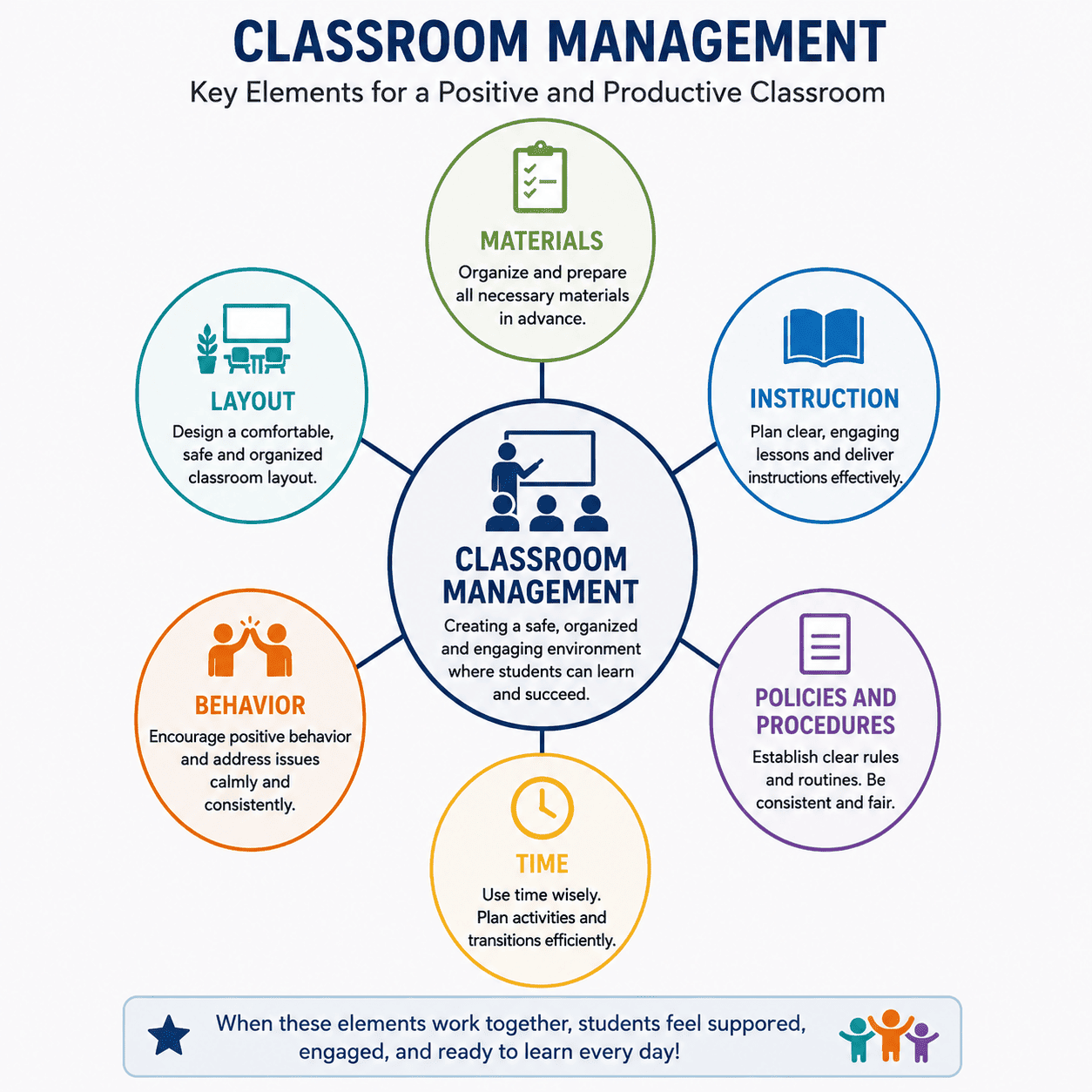
Practical classroom management tips for new and experienced teachers — clear routines, positive reinforcement, and calm ways to handle misbehavior.
Classroom Management Tips That Really Work
Every teacher can recall a period in a class where things just went wrong. Students are rowdy and just ignore your directions and by the tenth minute of your lesson plan everything is just going wrong. I know, because I am a teacher. Finding classroom management tips, which can be effective in a classroom, rather than on paper, can be challenging for even the most experienced educators.
This guide will give you some practical advice for managing a classroom, whether you are new to teaching or are looking to improve a method you have used for twenty years.
What Is Classroom Management?
Classroom management tips can include such areas as classroom organization classroom layout, and classroom rules, as well as techniques used by instructors to ensure proper conduct of students and methods to resolve misbehavior. All of these classroom management tips can have a great influence on the quality of the education process and learning results.
In fact, classroom management is not about controlling students, it involves setting up an environment conducive to learning, and can be seen as the invisible curriculum that enables an effective lesson to take place.
Why Classroom Management Matters
A classroom without management tends to run wild and lose focus. The importance of managing a classroom using the right tip is just as important as planning the lesson itself.
Strong classroom management benefits everyone:
- Students know what’s expected, which reduces anxiety and builds consistency.
- Teachers spend less time correcting behavior and more time teaching.
- Parents appreciate clear expectations and consistent communication.
Classroom management tips also helps students develop important life skills like responsibility and teamwork as well as saves time that would otherwise be spent disciplining students.

Common Classroom Management Challenges
Every classroom is different, but most teachers encounter similar challenges.
- Disruptive behavior: Talking, interrupting, or distracting classmates can reduce learning time for everyone. Consistent expectations work better than emotional reactions.
- Low engagement: Distractions from technology and personal life make focus harder to hold. Short breaks and interactive activities help sustain attention.
- Time management: Balancing lesson planning, grading, and daily routines is difficult without efficient systems that keep lessons flowing smoothly.
Every teacher faces classroom challenges. The best classroom management tips focus on consistent routines, clear expectations, and positive relationships. By using these strategies consistently, you can prevent many behavior issues and create a supportive, organized, and productive learning environment.

15 Effective Classroom Management Tips
Successful classroom management practice cannot be built on the basis of a single element. It can be constructed from a combination of techniques that, when used together, produce a beneficial effect.
- Set clear expectations from day one:
Students should be advised of the classroom rules, procedures, expectations, and assignments. - Explain, model, and practice rules:
Teachers need to explain, demonstrate, and practice rules and procedures rather than simply telling students. - Build positive relationships:
Develop positive relationships by being friendly when they greet students at the door, learning names quickly and asking questions about student interests. - Celebrate achievements:
Show approval for a good job done well by them, because students will be more likely to act appropriately if they feel they are being appreciated. - Be consistent:
Be firm but fair. Rules lose effectiveness when enforced differently from one day to the next. - Apply consequences predictably:
Consequences should be predictable so that students know they will have to face them if they do something wrong. - Use positive reinforcement:
Good behavior should be positively reinforced, and bad behavior should only be punished, not rewarded. - Offer simple rewards or leadership opportunities:
Offer small incentives for good behavior, or position’s of responsibility. - Keep lessons interactive:
Keep lessons interactive. Use discussions, collaborative activities, and problem-solving tasks. - Connect lessons to real life:
Use real-life examples and applications whenever possible. - Plan transitions carefully:
Plan transitions, not just lessons; make sure to allow time between transitions. - Address behavior privately:
Do not address behavior issues in front of the whole class. - Give students meaningful responsibilities:
Make sure to give the students jobs or allow them to take responsibility. - Use technology intentionally:
Utilize technology in the classroom, but do not rely on them too heavily - Adjust your approach by age group:
Modify the approach based on the age group, since different tactics work for different ages.
Real-life example:
A first-year middle school teacher struggled with noisy transitions between activities. She introduced a simple rule: when she raised her hand, students had five seconds to stop talking and raise theirs too. Within two weeks, transitions that used to take five minutes took less than one.
Manage Transitions Smoothly
Poor transitions are one of the biggest causes of lost learning time. A lesson may start well but fall apart when students shift from one activity to the next without clear direction.
Instead of saying something vague like, “Okay, let’s move on to our next activity”, try to give more explicit directions for your students. Helpful tools include:
- Displaying instructions on the board
- Using timers or countdowns
- Practicing transition routines early in the year
- Praising groups that transition quickly and quietly
By practicing and enforcing these procedures consistently students will begin to do them without being asked. It may seem tedious to constantly practice transitions early in your school year, but it will save you so much time in the long run and students won’t need as much reinforcement later.

Handle Misbehavior Calmly and Consistently
How a teacher responds to misbehaving students often determines whether the situation will improve or escalate. Here are some pointers on handling misbehavior:
- Stay calm: Remain calm. Students mirror their teacher’s emotional tone, so patience helps de-escalate tension.
- Address issues privately: Take disciplinary action in private as shaming in public can lead to the student becoming more defiant.
- Focus on the behavior, not the label: Focus on the behavior, not the label. “Let’s work on staying focused” works better than calling someone disruptive.
- Be consistent: Be firm but fair as well as consistent with consequences for misbehavior as well as rewards for positive behavior.
Encourage Student Responsibility
Students who take responsibility for their learning are often more engaged and manageable.
- Assign classroom jobs
Give them jobs in the classroom, like being your technology assistant or discussion leader - Encourage goal setting
Also try encouraging goals and letting students take control on small decisions - Offer choices
Give students options about how they can be responsible to show that you trust them
Responsibility doesn’t have to be complicated. Even small opportunities, like letting a student track the class’s weekly reading goal or lead a two-minute warm-up activity, shift the classroom dynamic from “the teacher controls everything” to “we manage this together.”
Classroom Management Tools and Techniques Table
| Tool/Technique | Best For | Age Group |
| Visual behavior charts | Building routine awareness | Elementary |
| Class points/reward systems | Motivating group behavior | Elementary to Middle |
| Seating charts | Reducing distractions | All ages |
| Digital classroom apps | Tracking behavior and communication | Middle to High |
| Restorative conversations | Repairing relationships after conflict | Middle to High |
| Timers and countdowns | Managing transitions | All ages |
Classroom Management Tips Or Strategies by Age Group
No single approach works for every age. Some classroom management tips and strategies are given below:
- Elementary: Needs structure, visuals and lots of positive reinforcement.
- Middle school: Responds better to a firm -yet respectful approach and collaboration on rules and expectations.
- High school: Favors independence, relevance and project-based learning over rewards and praise.
Adapting your approach based on age doesn’t mean you’re not challenging or motivating students, it means you’re more likely to meet them where they are, so you can be effective in getting your message across.
Mistakes Teachers Should Avoid
- Controlling every minor behavior
Controlling everything, even the slightest behaviors, causes tension and distraction; focus on things that interfere with the teaching process. - Being inconsistent
Inconsistent responses demoralize and confuse students, as they never know what to expect. - Relying only on punishment
Only giving the punishment discourages, but positive reinforcement motivates and inspires longer-term change. - Neglecting relationships
Ignoring relationships leads to unproductive classes, as students feel disrespected.
Most issues come from good intentions; teachers want to set up their classrooms in such a way that it’s organized and students thrive. By using these classroom management tips, teachers can avoid these issues in the first place and prevent them from arising, as well as fix the ones they do occur.
Frequently Asked Questions
1. What are the most important classroom management tips for new teachers? Set clear expectations early, build relationships, stay consistent, and plan routines before the school year starts.
2. How can I manage a classroom without yelling? Use calm, private conversations, plan transitions carefully, and apply consistent consequences instead of raising your voice.
3. How is classroom management different for elementary versus high school students? Elementary students need structure and visual routines; high school students respond better to autonomy and real-world relevance.
4. What’s the best way to handle a disruptive student? Address the behavior privately, focus on the action rather than labeling the student, and apply consequences fairly and consistently.
5. How can technology help with classroom management? Used intentionally, it boosts engagement and simplifies organization — but clear usage rules are essential to avoid distraction.
6. What’s the biggest mistake teachers make with classroom management? Inconsistency. When rules shift depending on the day, students lose trust in the system.
Conclusion
Effective classroom management tips are all about having proper routines, developing good relationships, and taking actions that put students at ease so they can learn and develop a sense of responsibility. In all of these, you can see the importance of managing the class in an appropriate, predictable manner that puts students at ease while still holding them to high standards.
Do not be overwhelmed by the idea of classroom management. The best classroom management tips are the ones you actually use, so start small, try a couple, see what your students respond to, and keep adding new ones from the list as you learn more about what your class needs. Classroom management is a skill that must be acquired, honed, and adapted as the needs of a given class change and grow. Classroom management tips are an essential part of being a good teacher as every accomplished educator was once a novice who had to build his or her skills from the ground up.